Case study · AI answers from your docs
ResolveAI
AI support assistant that answers customer questions from your own help articles, with an embeddable chat widget.
Answers cite the articles they come from; questions it can't answer are collected instead of guessed.
- Type
- Personal open-source project
- Automated tests
- 41 (pytest)
- Built with
- Python · FastAPI · SQLAlchemy
- Live demo
- Runs locally — not hosted
Overview
What it does
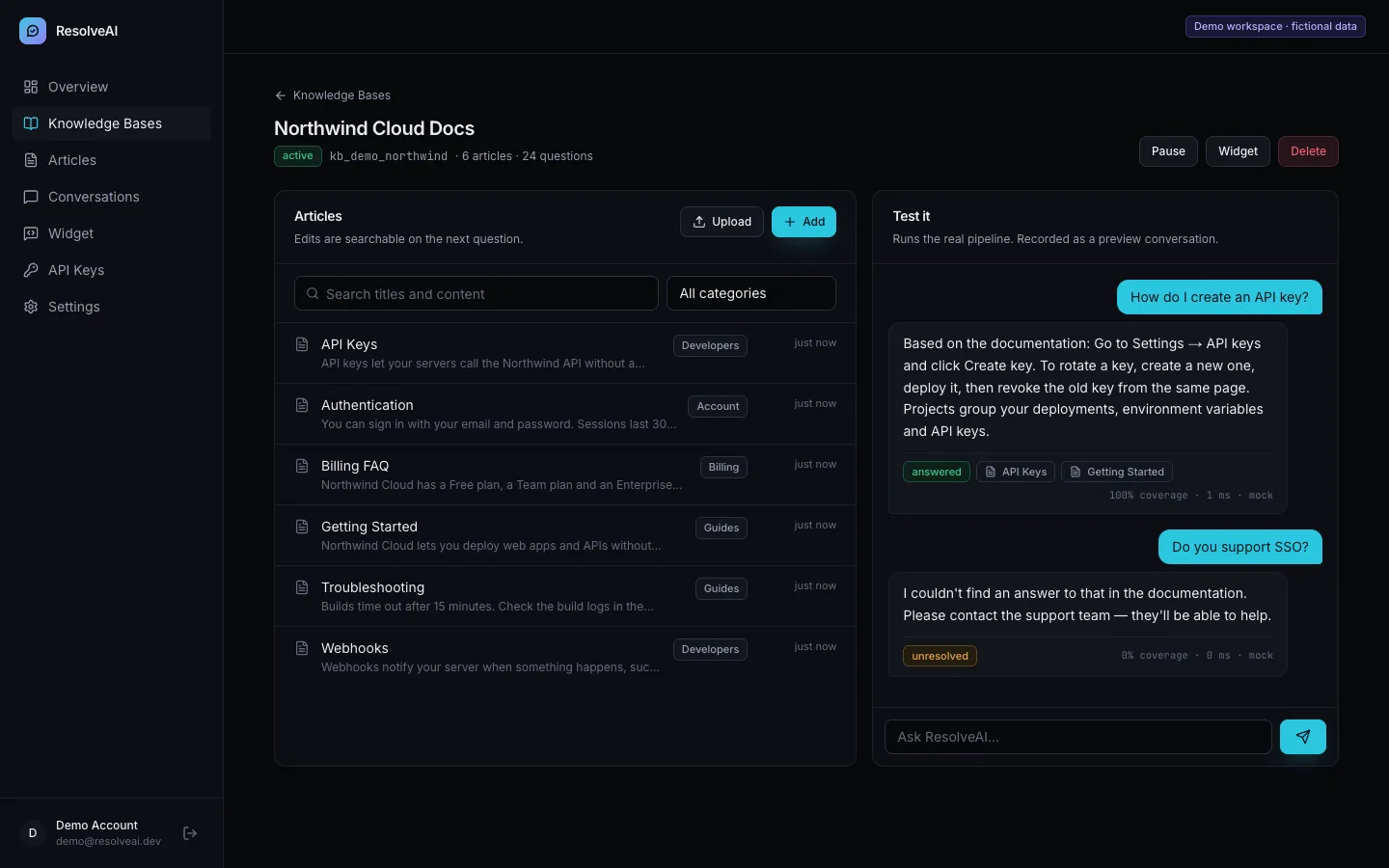
ResolveAI answers customer questions from your help articles through an embeddable chat widget and a developer API. Each answer lists the articles it came from; when the articles don't cover a question, it says so and logs the question as unresolved. It runs without an AI key: the default mock provider builds answers from article sentences, and AI_PROVIDER=openai switches to any OpenAI-compatible endpoint.
Problem
A support chatbot that answers everything confidently is worse than none: it invents policies, and nobody learns which questions the docs fail to cover.
Solution
Retrieval decides first. If the retrieved passages don't cover the question well enough, the model is never called — the visitor gets a plain “I couldn't find that” and the question goes to the dashboard. When it does answer, a citation only counts if that article was actually retrieved.
Screenshots
From the running application
Knowledge base with the test chat and cited sources 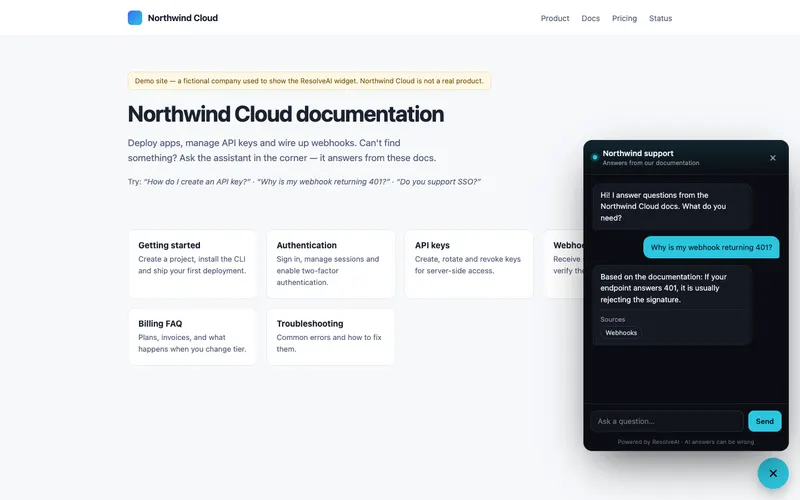
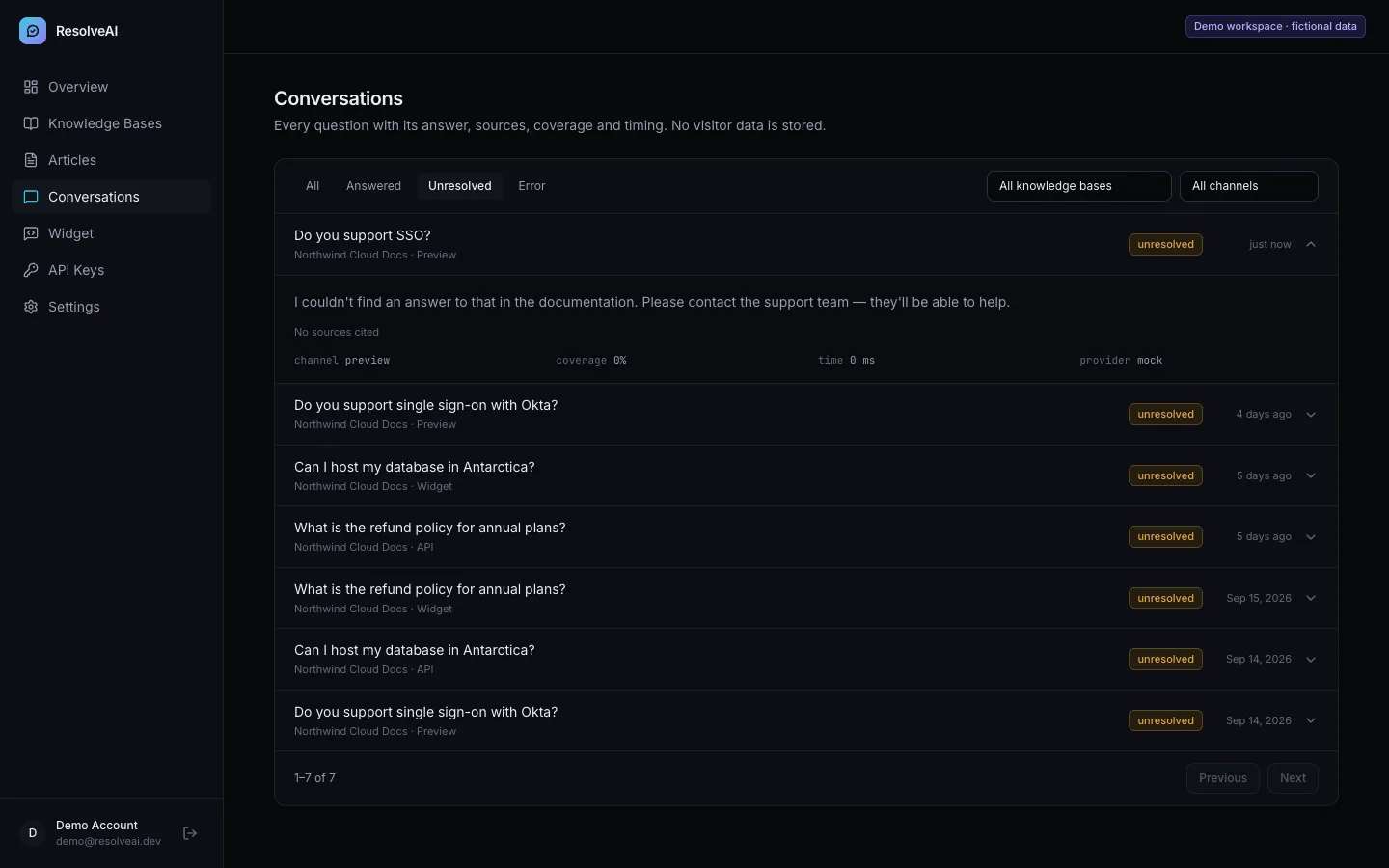
The embeddable widget answering on a demo customer site 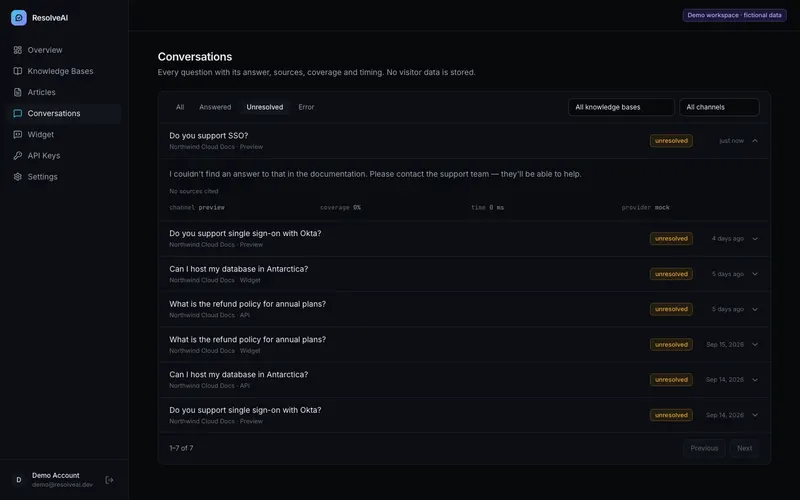
Unresolved questions to turn into articles 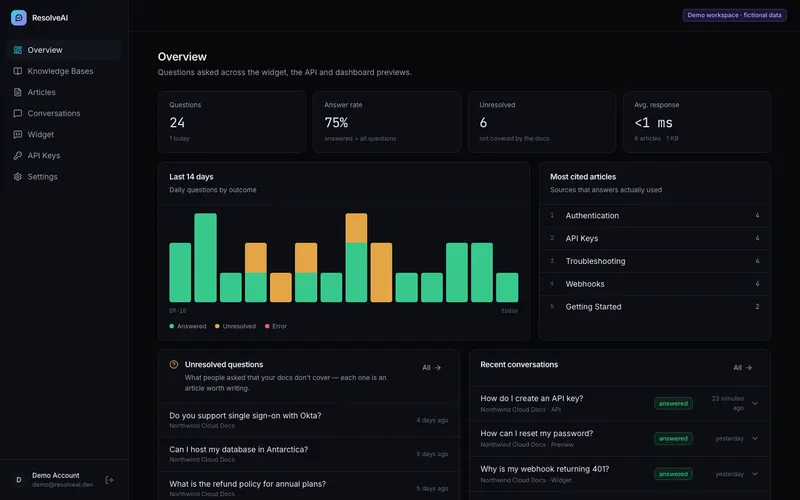
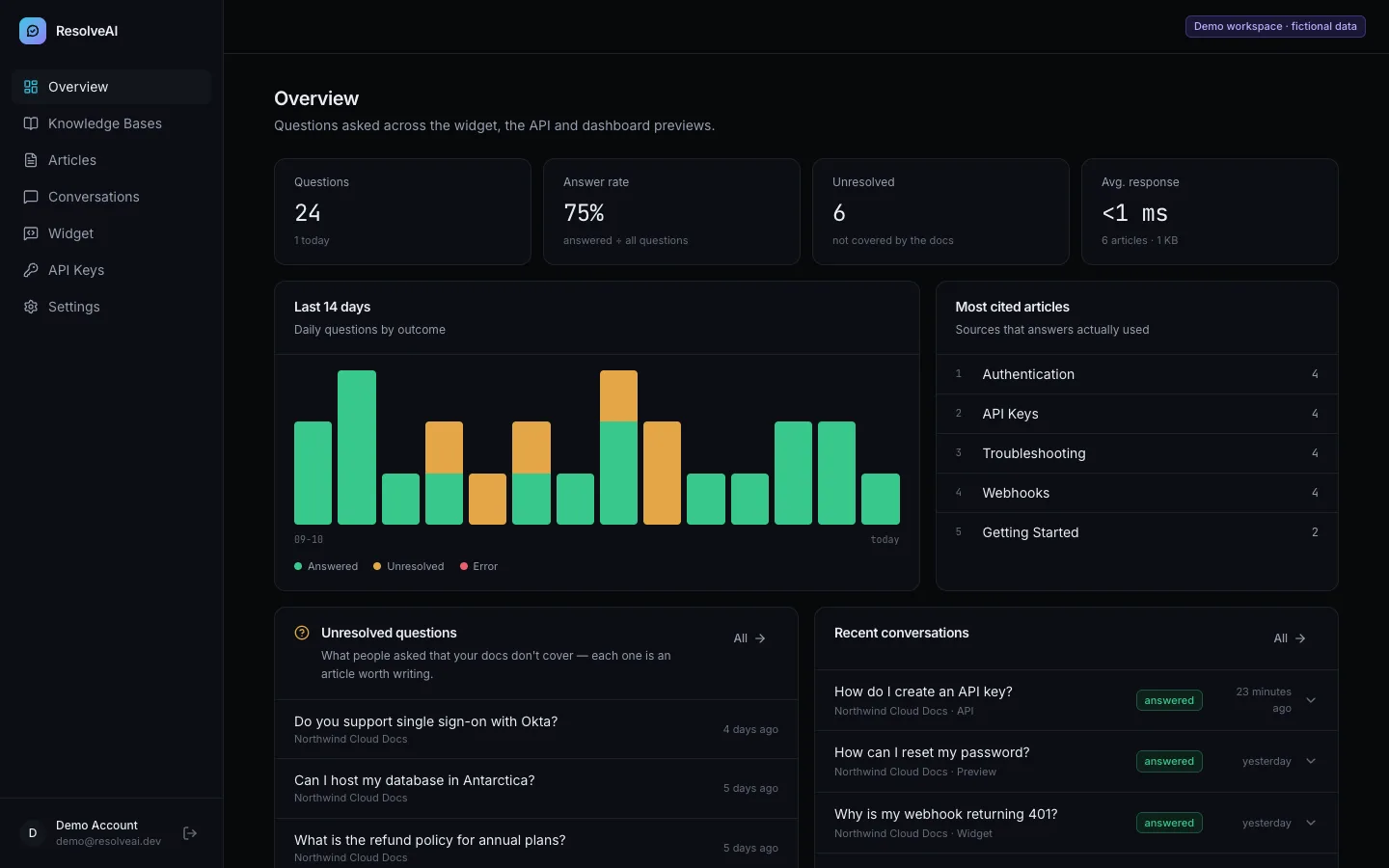
Overview with answer rate and most-cited articles 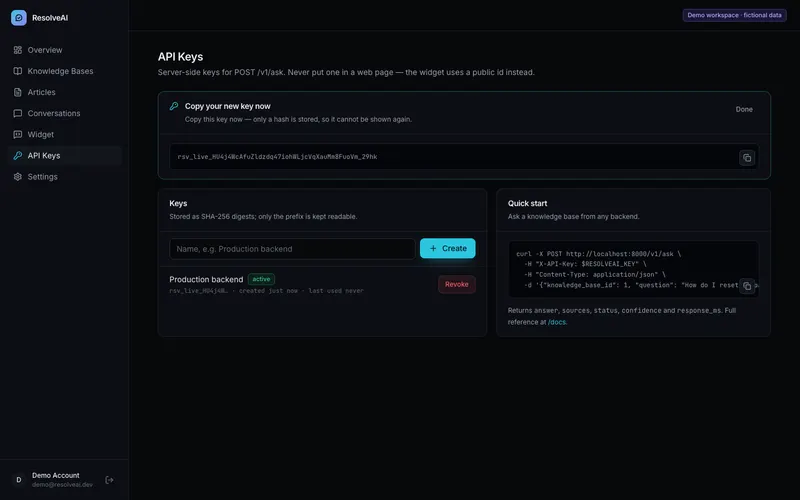
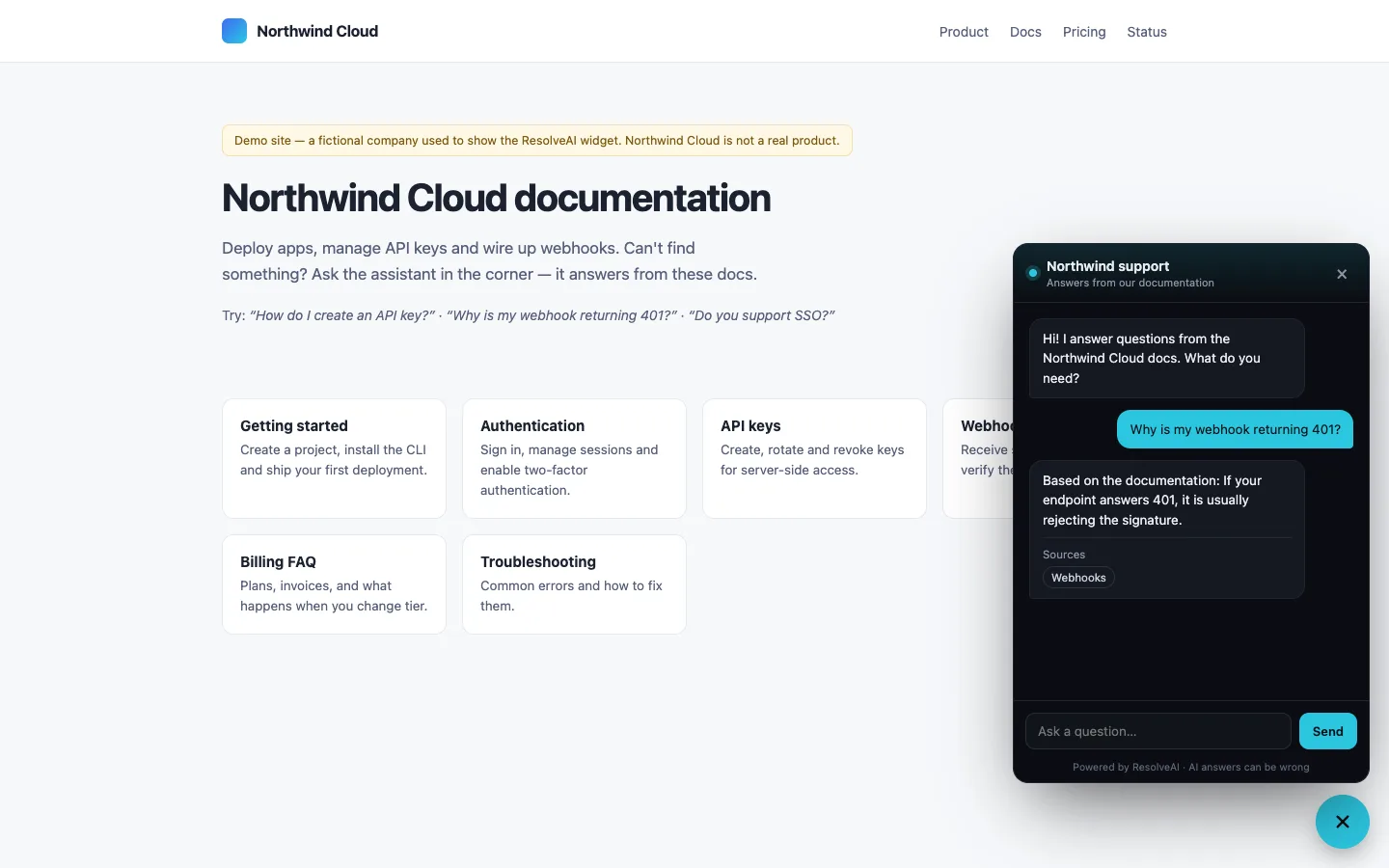
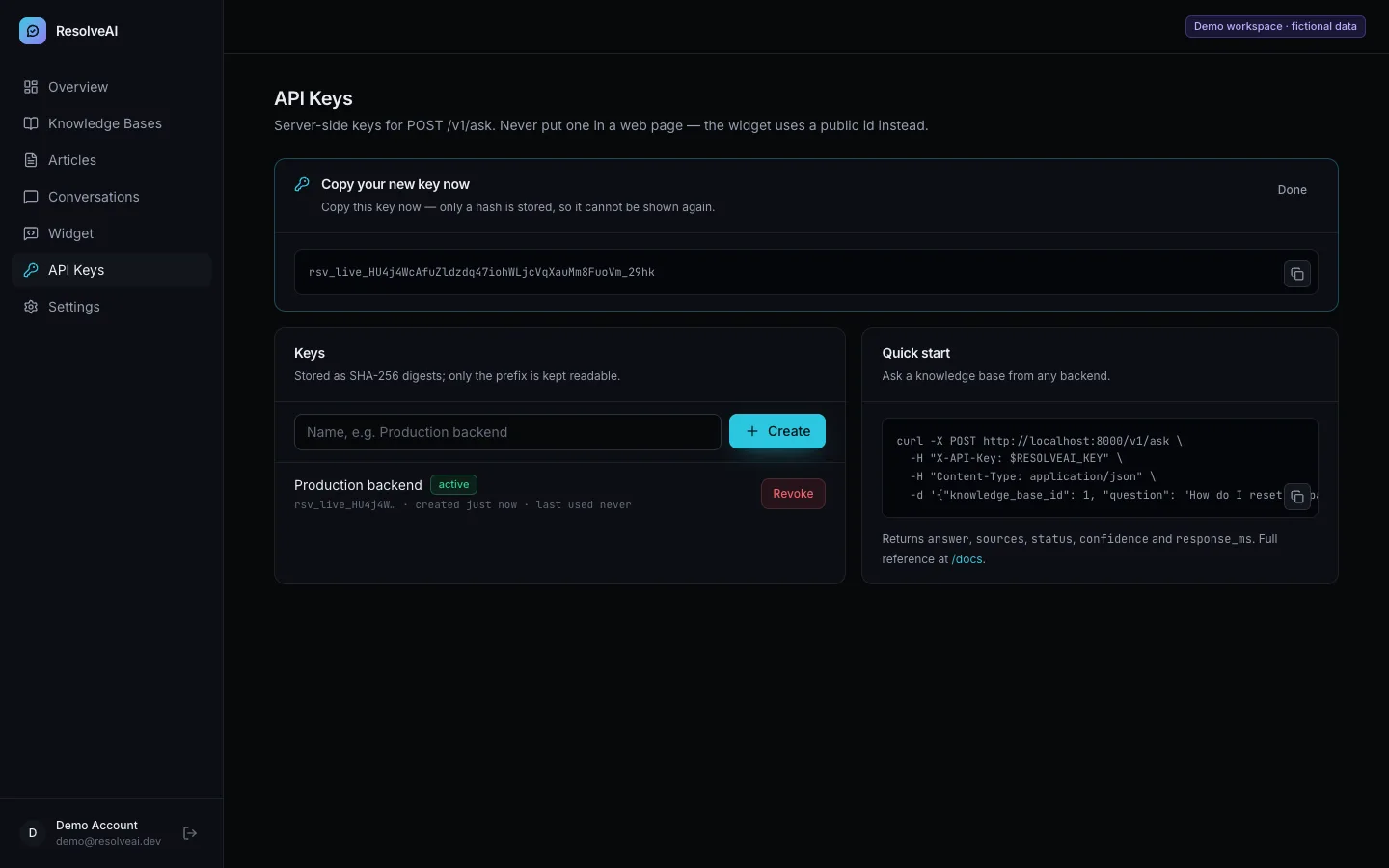
API keys, shown once
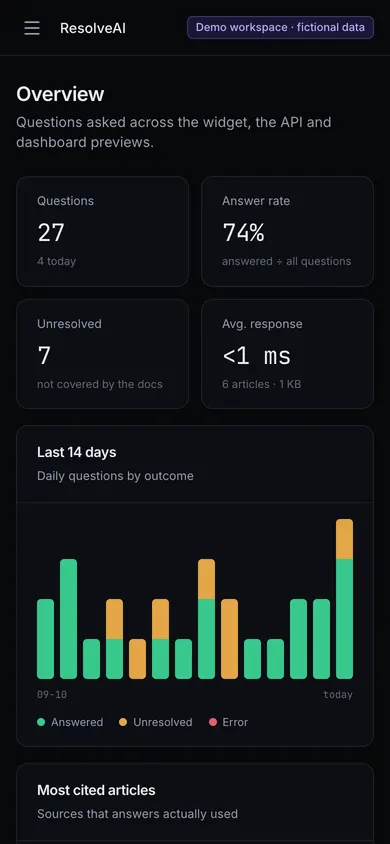
Overview on a phone
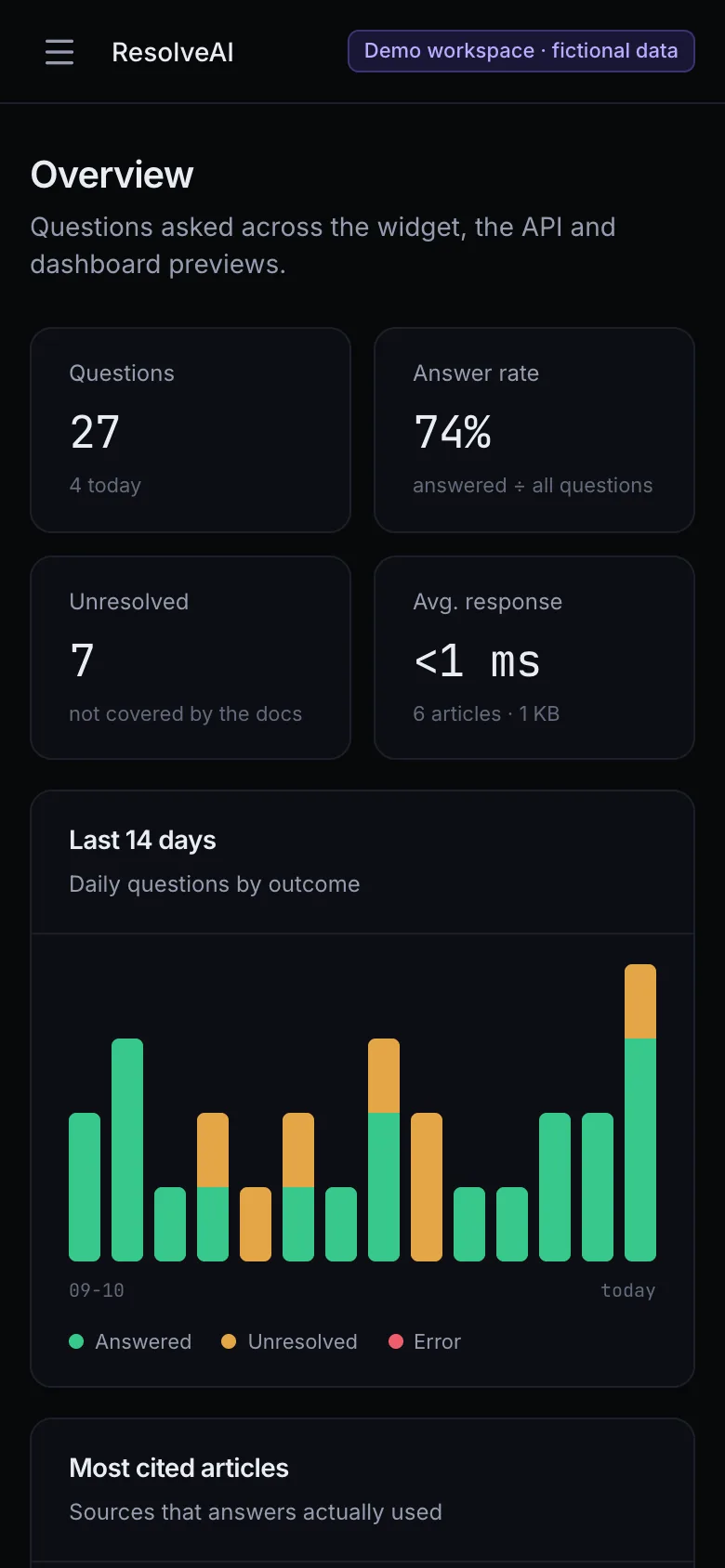
Captured from the app running locally with its seeded demo data. Select an image to open it full size.
Architecture
How the pieces fit
- Dashboard → Answering service
- Widget → Answering service
- /v1/ask → Answering service
- Answering service → BM25 retrieval
- BM25 retrieval → Coverage gate
- Coverage gate → AI provider
- Coverage gate → Unresolved list
- AI provider → Cited answer
- Core service
- External system
- Storage / entry point
Core features
What's in it
Knowledge bases
Markdown articles or .md/.txt uploads; the index reflects every edit on the next question, with no re-indexing job.
Grounded answers
Only retrieved passages reach the provider, and citations are cross-checked against what was retrieved.
Unresolved questions
Low-coverage questions skip the model and become a to-write list on the dashboard.
Embeddable widget
One script tag, about 11 KB, rendered in a Shadow DOM, with a server-enforced domain allowlist and rate limits.
Developer API
POST /v1/ask with X-API-Key; keys SHA-256 hashed at rest, shown once, revocable.
Pluggable AI
A small provider protocol: extractive mock provider, or OpenAI-compatible Chat Completions with structured output.
Technical decisions
Interesting problems, and how they're solved
- 01
Retrieval gates the model
Heading-aware chunking and BM25 with title/heading terms weighted ×2; below a score and coverage threshold, the model isn't called at all.
- 02
Citations are verified, not trusted
The provider returns article ids; only those that were retrieved for this question are shown as sources.
- 03
Three surfaces, one pipeline
The widget, the API and the dashboard's test chat call the same answering service.
confident = (
    bool(retrieval.passages)
    and retrieval.top_score >= settings.retrieval_min_score
    and retrieval.coverage >= settings.retrieval_min_coverage
)
if confident:
    try:
        reply = await provider.answer(question, retrieval.passages)
    except ProviderError as exc:
        logger.warning("Provider %s failed: %s", provider.name, exc)
        result.answer = ERROR_MESSAGE
        result.status = ConversationStatus.ERROR
        error = str(exc)[:255]
    else:
        error = None
        retrieved = retrieval.article_ids()
        # Only articles that were both retrieved and cited count.
        cited = [aid for aid in reply.cited_article_ids if aid in retrieved]
        if reply.answerable and reply.text:
            result.answer = reply.text
            result.status = ConversationStatus.ANSWERED
            result.sources = _describe(db, cited, retrieval)
        else:
            result.answer = reply.text or NOT_FOUND_MESSAGE
else:
    error = None
Stack & skills
Built with
Technology
- Python
- FastAPI
- SQLAlchemy
- httpx
- OpenAI-compatible API
- Next.js
- TypeScript
- Vanilla JS widget
What this project demonstrates
- AI integration (RAG)
- Search & ranking
- Public API design
- Embeddable widgets
- Full-stack SaaS
Repository & demo
Run it yourself
Runs with the free mock provider by default; the demo knowledge base describes a fictional product.
No public live demo is hosted. Everything below runs locally with Python 3.12+ and Node 20+.
$ git clone https://github.com/Moeijiro/resolveai.git
$ cd resolveai
$ make install
$ make seed
$ make api
$ make web
Have a project in mind?
I build APIs, automation systems, Discord integrations and full-stack applications. Tell me what it should do and I'll tell you how I'd build it.