Case study · OAuth2 dashboard · gateway bot
Discord Automation Platform
Dashboard and bot that automate a Discord server: verification, welcome messages, roles and an audit log.
Sign in with Discord; every change re-checks permissions with Discord before it runs.
- Type
- Personal open-source project
- Automated tests
- 49 (pytest)
- Built with
- Python · FastAPI · discord.py
- Live demo
- Runs locally — not hosted
Overview
What it does
A production-shaped platform for Discord server automation: sign in with Discord, configure verification, welcome messages and role automation for a server you administrate, and read back an audit trail of everything the automation did. The interesting part is the boundaries — OAuth2 tokens that never reach the browser, a permission gate that re-checks Discord, and automations that refuse to run when Discord would reject them anyway.
Problem
Server dashboards often trust a stale permission cache, hand OAuth tokens to the browser, and let role changes fail silently when the bot sits below the target role.
Solution
The OAuth2 code flow runs server-side with tokens encrypted at rest. Every write checks both sides — the caller's Manage Server permission and the bot's own permissions and role position — before calling Discord. The API and the gateway bot share one automation service, so a join event and a dashboard click behave identically.
Screenshots
From the running application
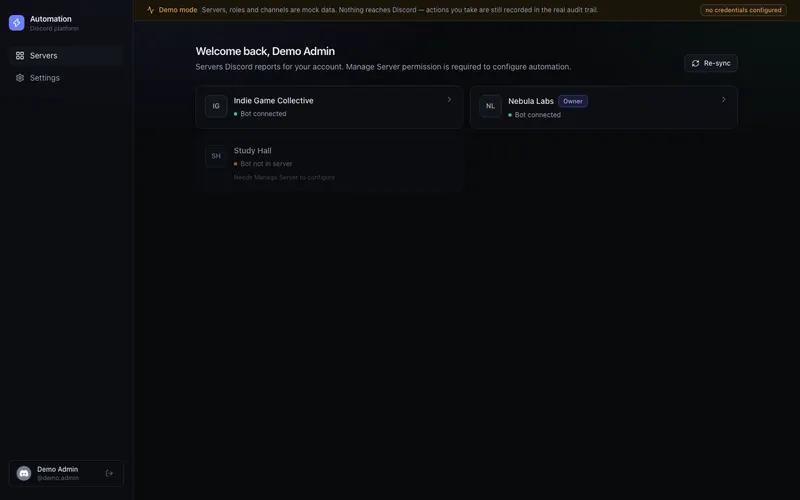
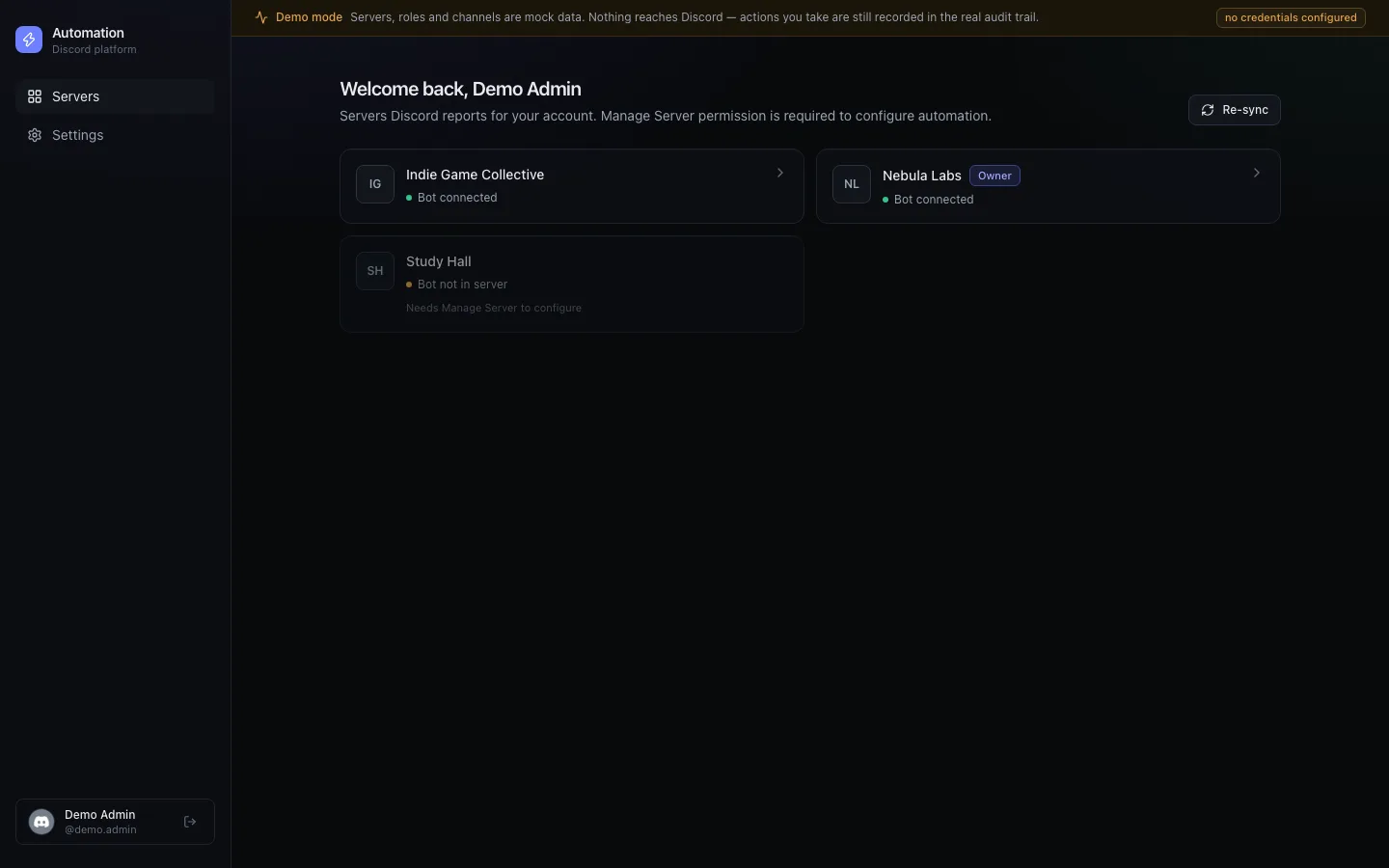
Server dashboard with bot status and permission state per server 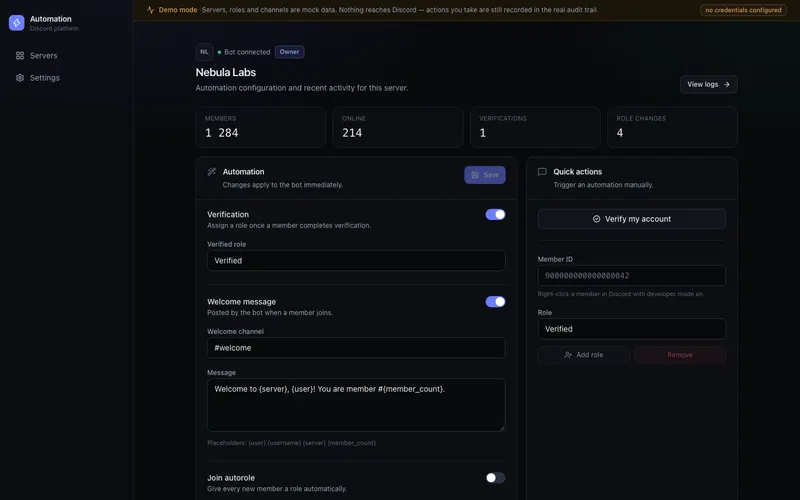
Per-server automation settings: verification, welcome message and roles 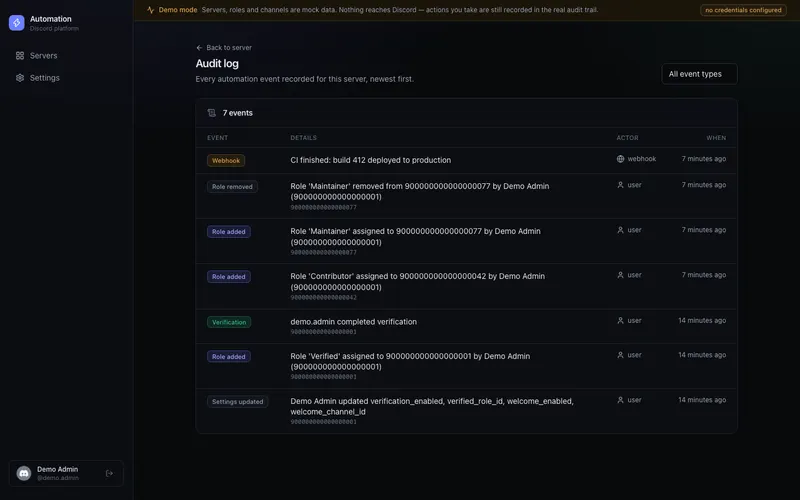
Filterable audit log of automation events 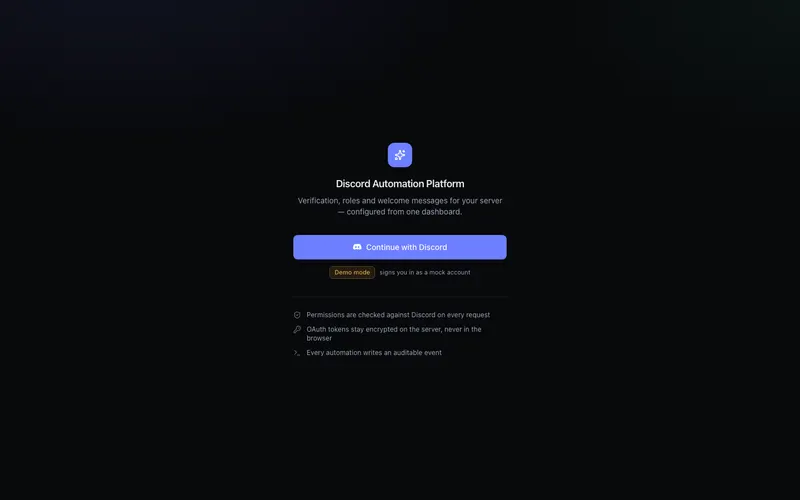
Sign in with Discord
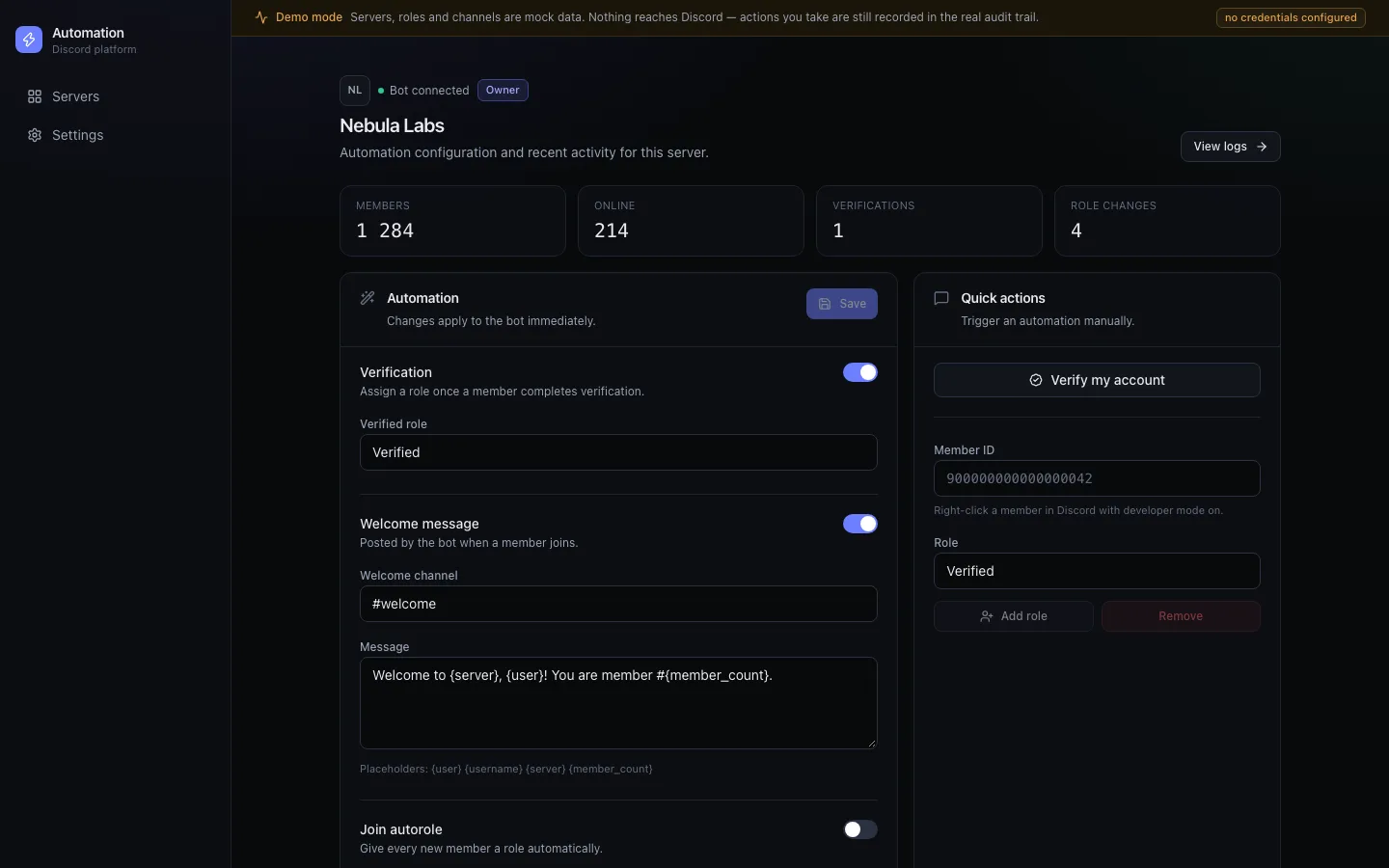
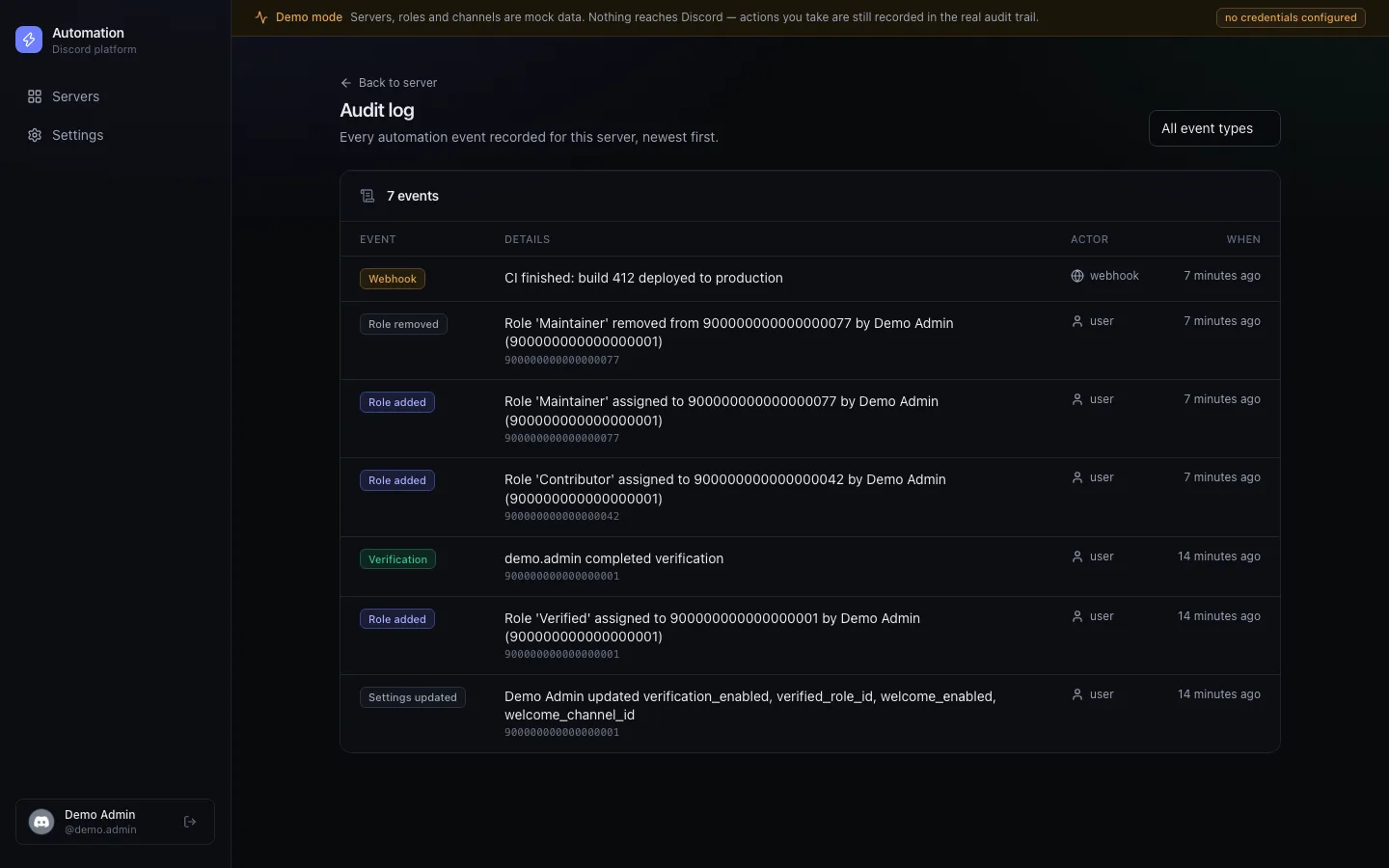
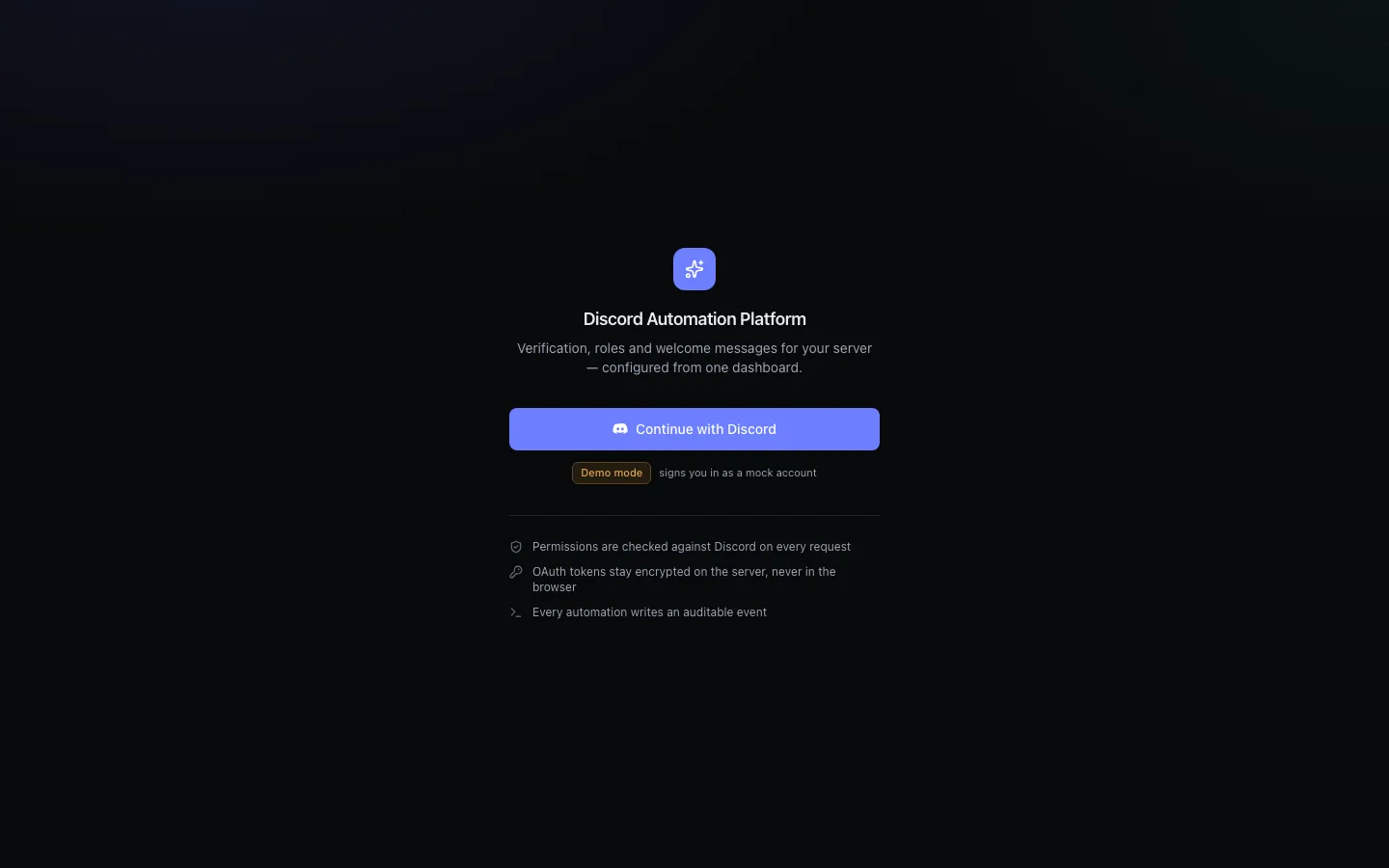
Captured from the app running locally with its seeded demo data. Select an image to open it full size.
Architecture
How the pieces fit
- Dashboard → FastAPI
- Discord gateway → Gateway bot
- FastAPI → Discord OAuth2
- FastAPI → Automation service
- Gateway bot → Automation service
- Automation service → Discord REST
- Automation service → Database
- Core service
- External system
- Storage / entry point
Core features
What's in it
Discord login
OAuth2 authorisation-code flow (identify, guilds); access and refresh tokens are Fernet-encrypted and never serialised into a response.
Verification & roles
Verified-role flow, role add/remove with the hierarchy and integration-managed roles respected, and an optional join autorole.
Welcome automation
Channel and message template with {user}, {server} and {member_count} placeholders, posted by the bot on join.
Audit trail
Every event — including automation_failed — stored with actor, target, guild and metadata, on a filterable, paged page.
Signed webhooks
POST /api/webhooks/custom accepts HMAC-SHA256-signed events, validated strictly and optionally announced in a channel.
Demo mode
A mock Discord client implementing the same interface; the demo never invents activity, and production refuses to boot with it on.
Technical decisions
Interesting problems, and how they're solved
- 01
Separate keys from one secret
Session signing and token encryption keys are derived from SESSION_SECRET through HKDF with different labels.
- 02
CSRF on the OAuth round trip
A random state per attempt, stored in a short-lived HttpOnly cookie scoped to /api/auth and compared in constant time.
- 03
Permissions are re-checked, not remembered
Guild membership and permission bitfields are re-read from Discord on login; ADMINISTRATOR implies everything, exactly as Discord treats it.
- 04
Two processes, one service
uvicorn serves the API and python -m app.bot holds the gateway; both import the same automation service.
def sign_payload(body: bytes, secret: str | None = None) -> str:
    """Return the ``sha256=<hex>`` signature expected in ``X-Signature``."""
    key = (secret or settings.webhook_secret).encode()
    digest = hmac.new(key, body, hashlib.sha256).hexdigest()
    return f"sha256={digest}"


def verify_signature(body: bytes, header_value: str | None) -> bool:
    if not header_value:
        return False
    return hmac.compare_digest(sign_payload(body), header_value.strip())
Stack & skills
Built with
Technology
- Python
- FastAPI
- discord.py
- Discord OAuth2
- SQLAlchemy
- PyJWT
- cryptography
- React
- TypeScript
- Vite
What this project demonstrates
- Discord OAuth2
- Discord REST & gateway
- Permission modelling
- Token security
- Audit logging
Repository & demo
Run it yourself
DEMO_MODE=true (the default) swaps in a mock Discord client with three servers and a demo sign-in.
No public live demo is hosted. Everything below runs locally with Python 3.12+ and Node 20+.
$ git clone https://github.com/Moeijiro/discord-automation-platform.git
$ cd discord-automation-platform
$ make install
$ make api   # FastAPI on :8000
$ make web   # dashboard
$ make bot   # optional, needs a bot token
Have a project in mind?
I build APIs, automation systems, Discord integrations and full-stack applications. Tell me what it should do and I'll tell you how I'd build it.