Case study · Web change monitoring
ScoutFlow
Watches public web pages for price, stock and content changes, and alerts you on Discord or Telegram.
Every fetch is SSRF-guarded, and a failed check is recorded as a failure, never as a change.
- Type
- Personal open-source project
- Automated tests
- 46 (pytest)
- Built with
- Python · FastAPI · httpx
- Live demo
- Runs locally — not hosted
Overview
What it does
ScoutFlow checks public pages and APIs on a schedule with five monitor types — text, price, availability, whole-page content and a JSON field — and shows exactly what changed. It alerts Discord, Telegram or a signed webhook, and treats a failed check as a failure with a precise reason, never as a change.
Problem
People refresh pages to catch price drops, restocks and policy edits, and naive monitors cry wolf whenever a page times out or a layout changes.
Solution
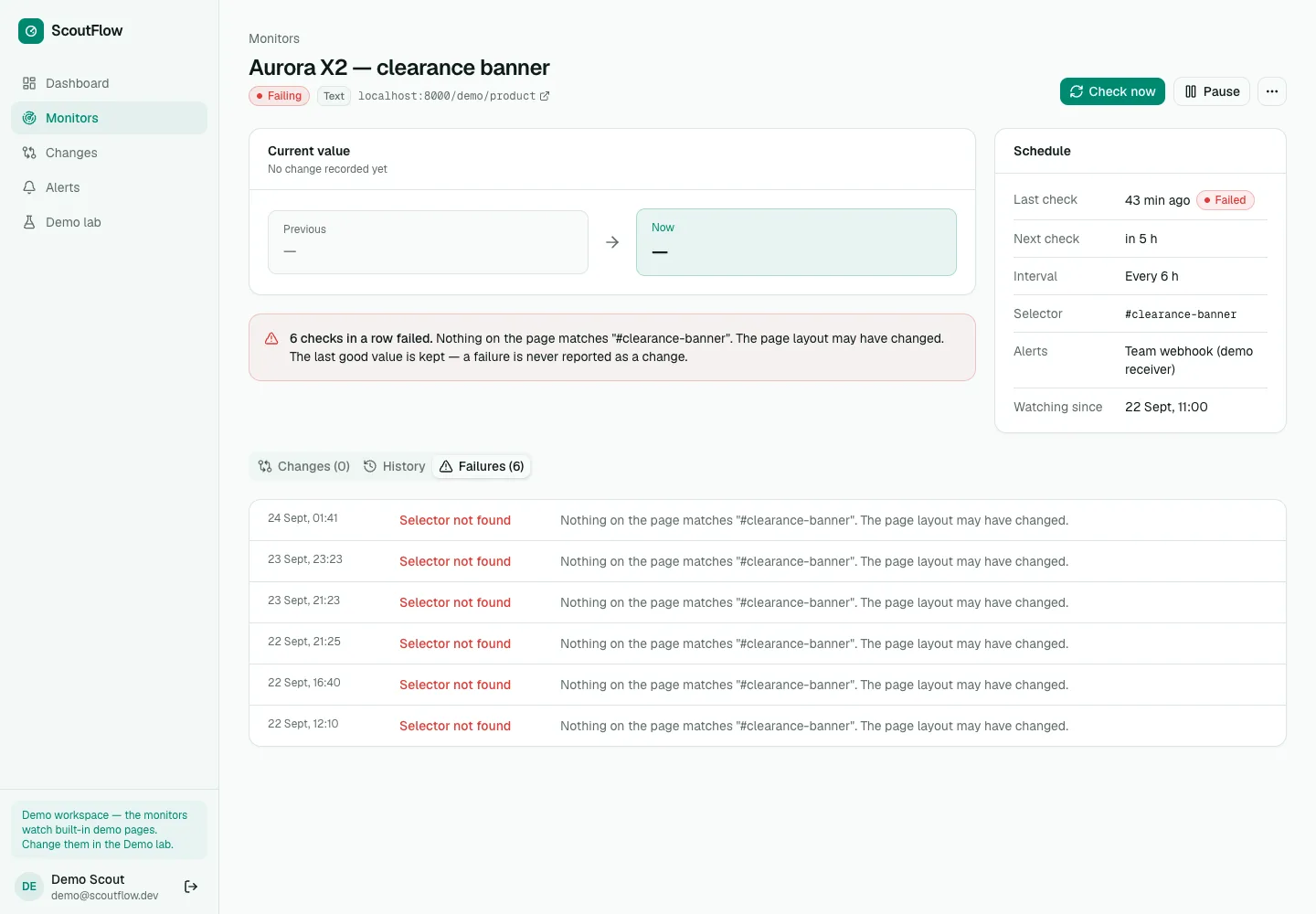
A staged check runner (fetching → extracting → comparing) records one of four outcomes: baseline, no change, changed or failed. A failure carries a type — timeout, network, HTTP error, blocked, selector missing, robots.txt, too large — and the last good value is kept, so recovery compares against real data.
Screenshots
From the running application
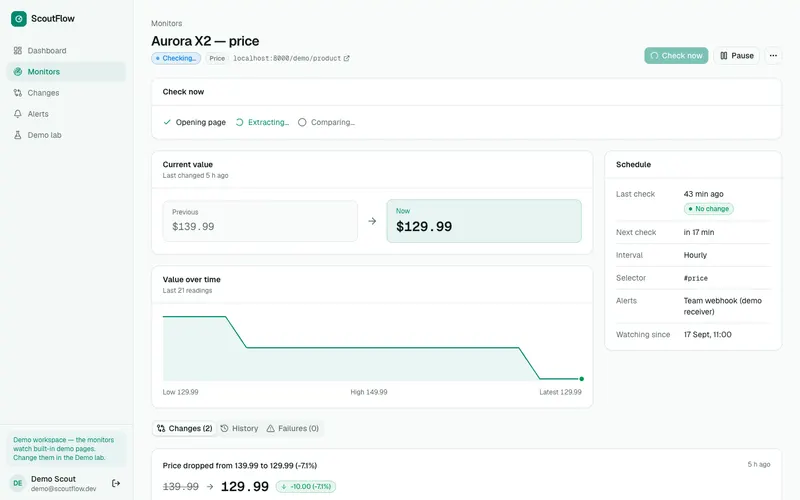
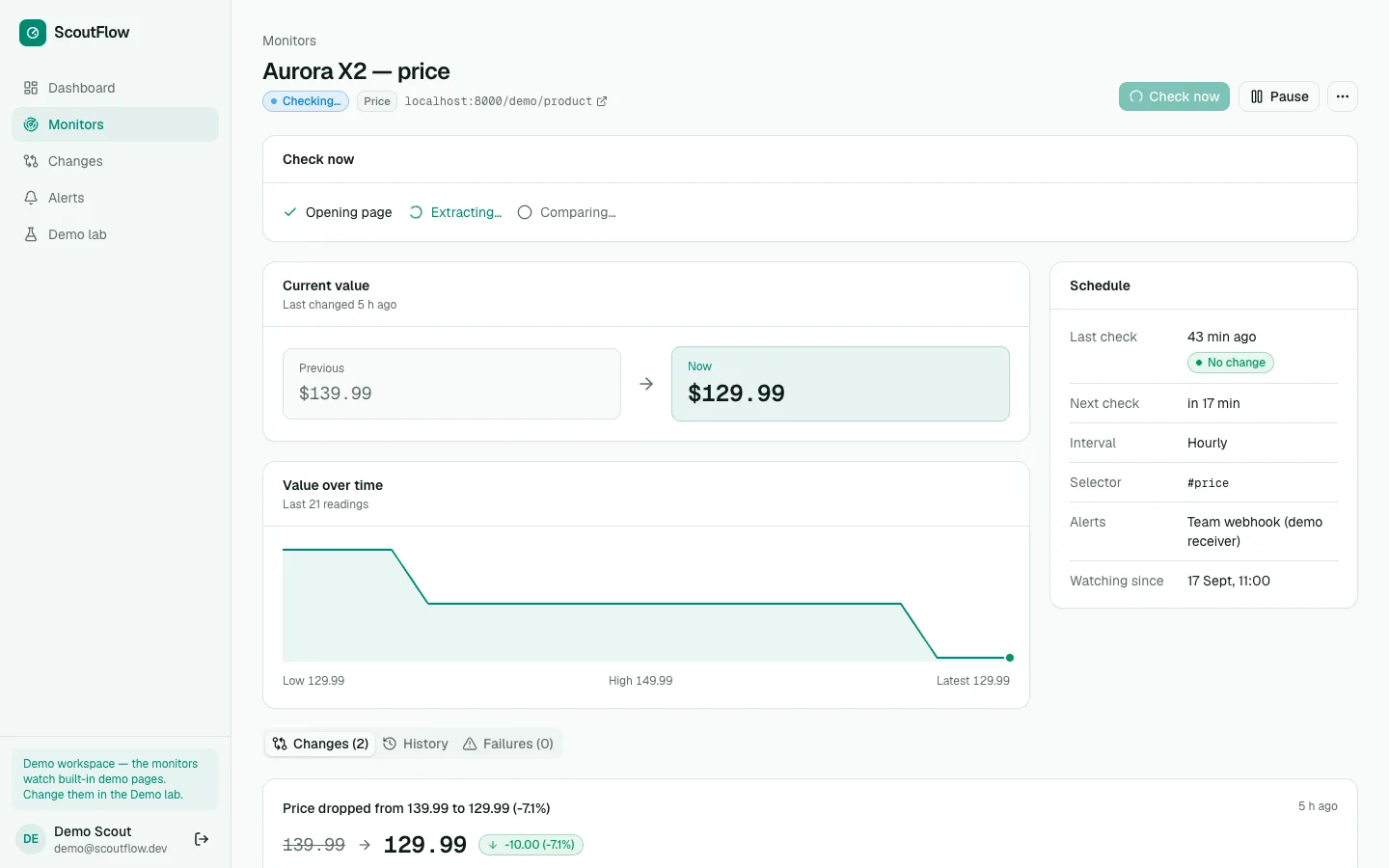
Check now in progress: opening page, extracting, comparing, change detected 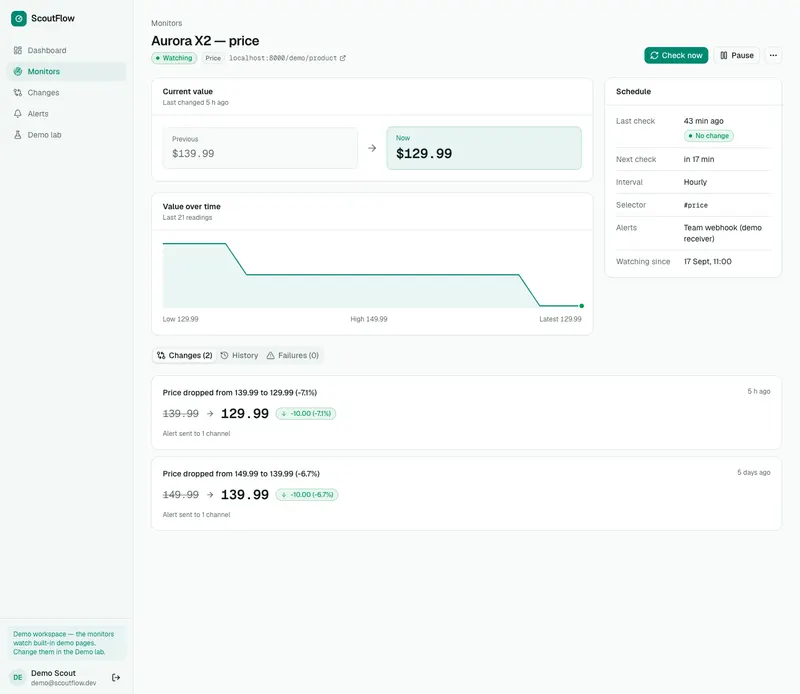
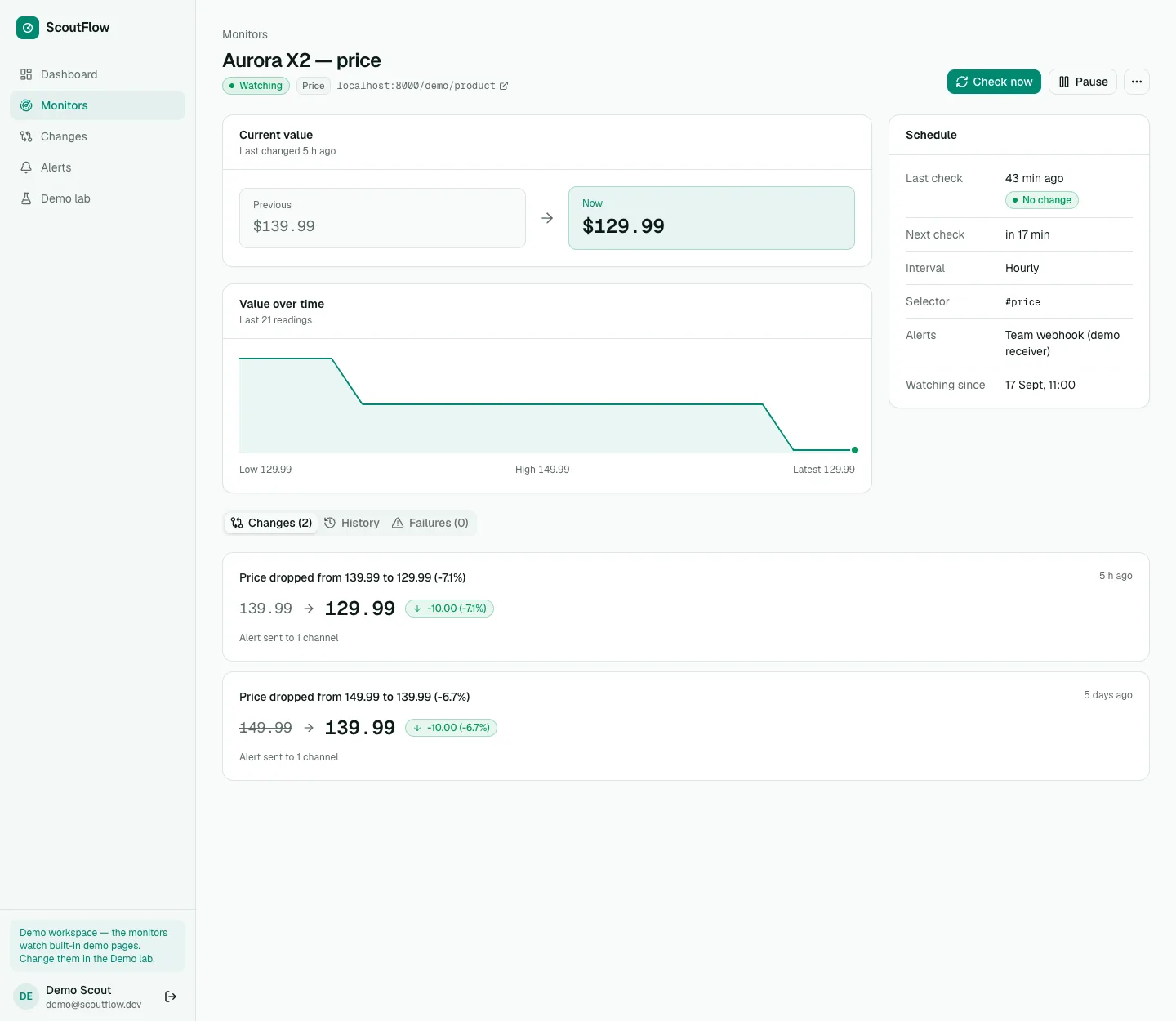
Price monitor with previous and current value and a price chart 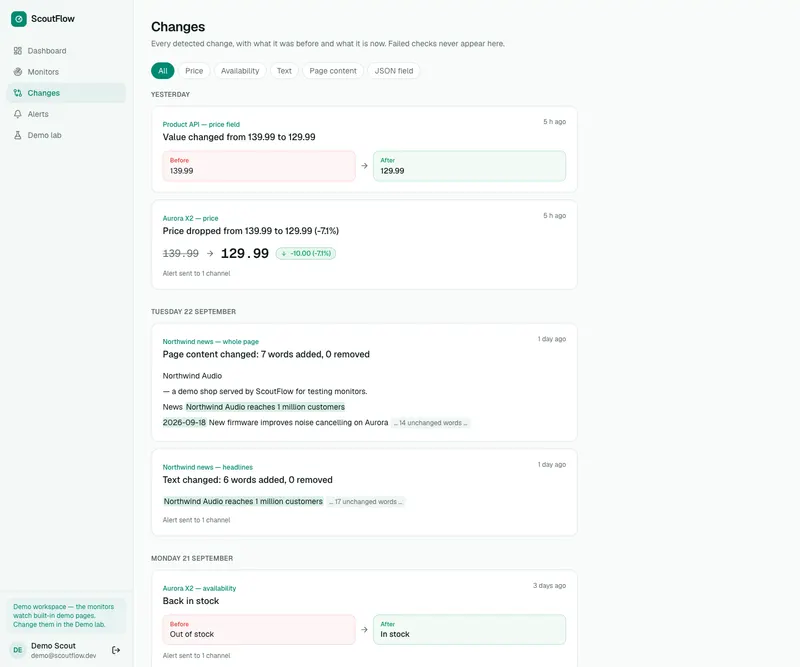
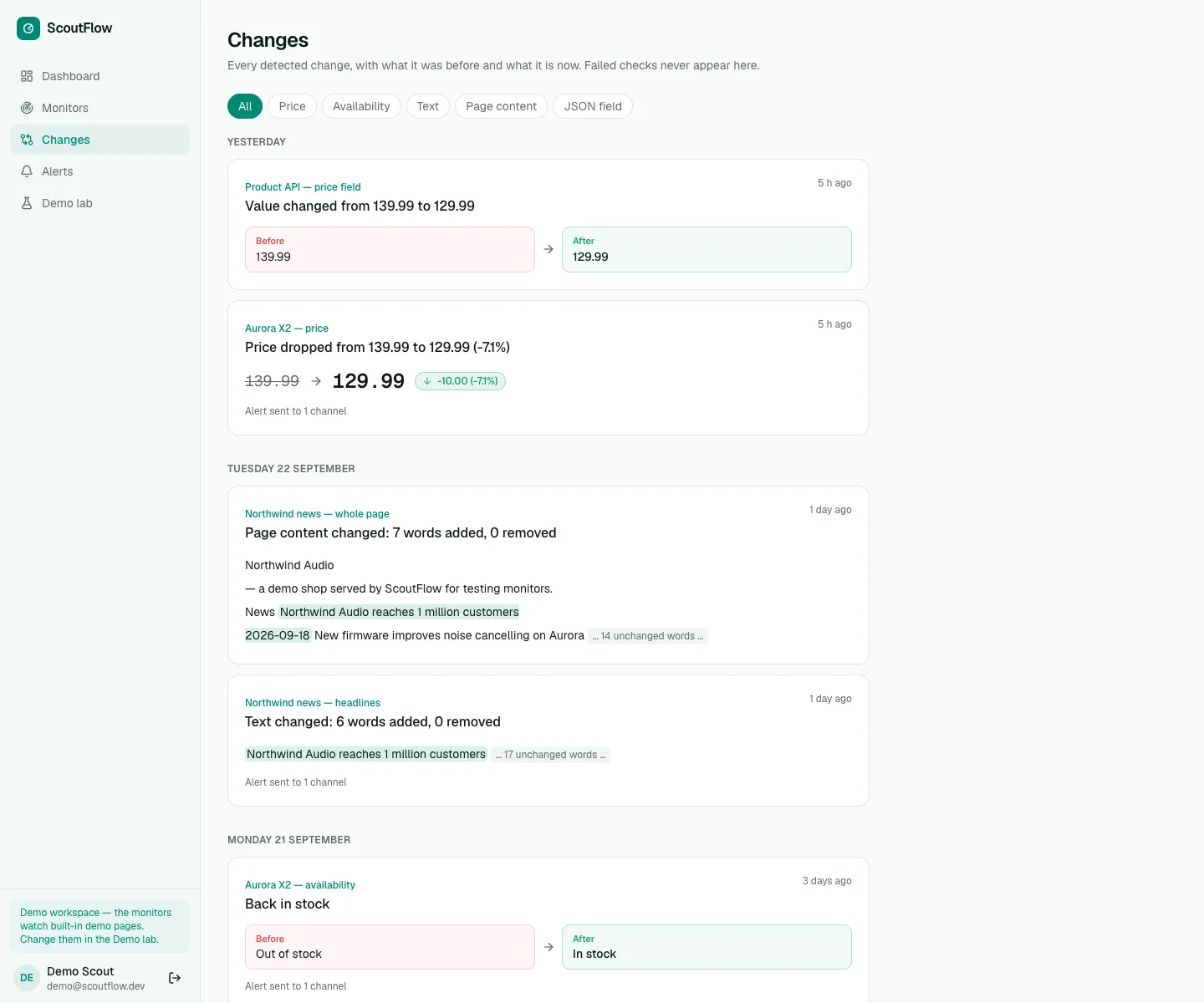
Change feed with a word diff of a headline and a stock transition 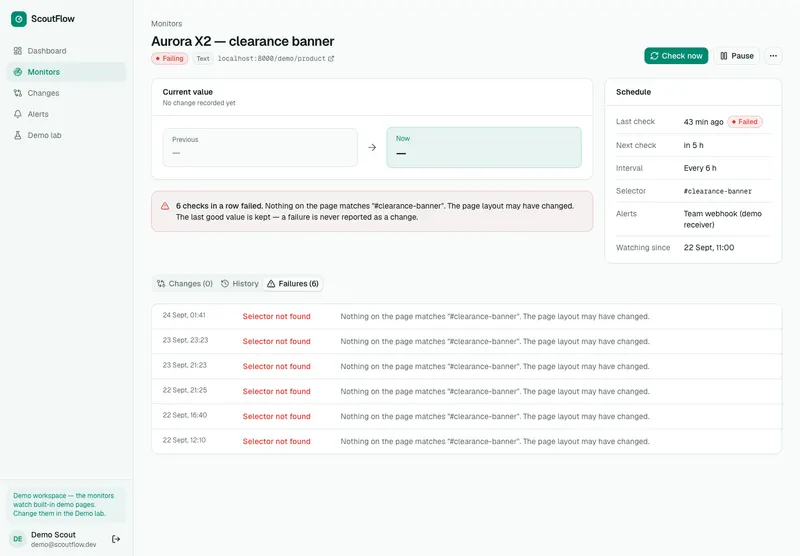
A failing monitor that keeps its last good value 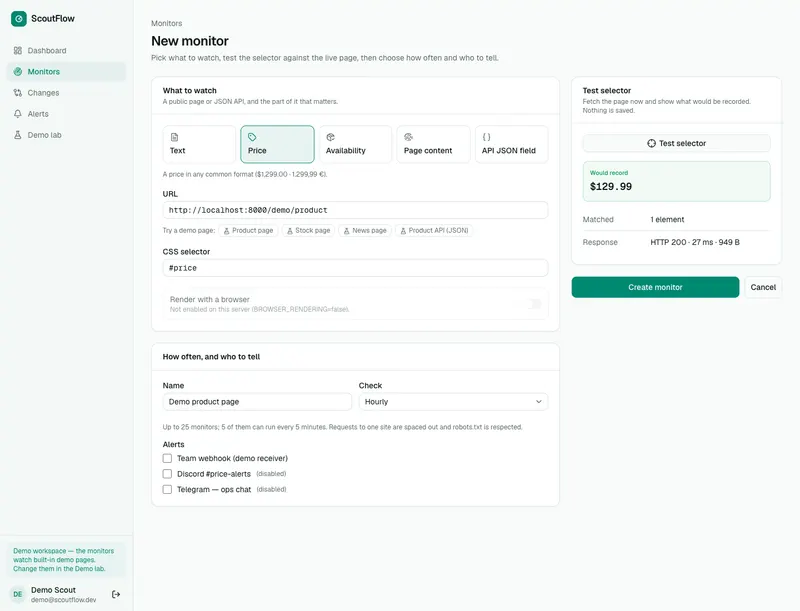
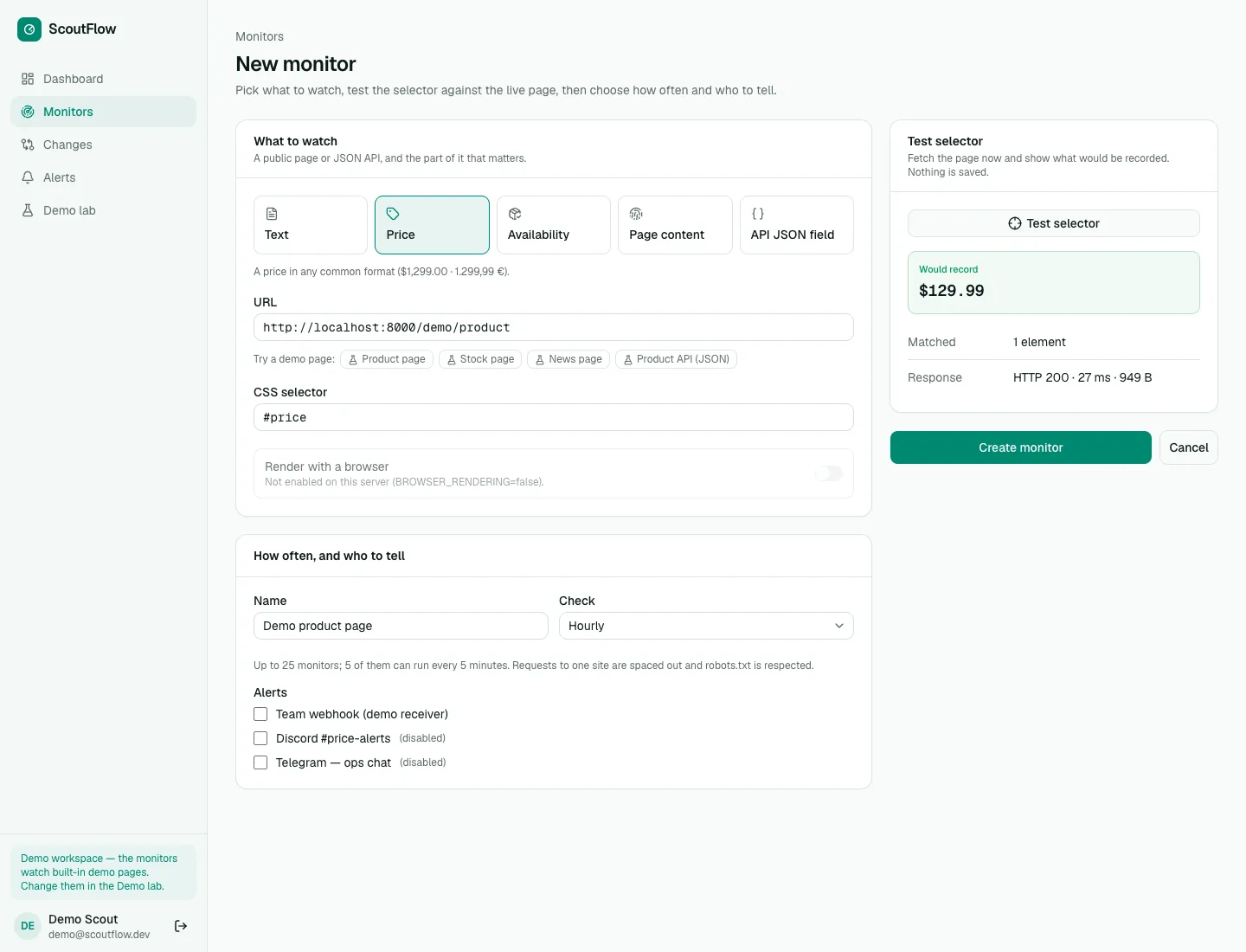
New monitor with a live selector test
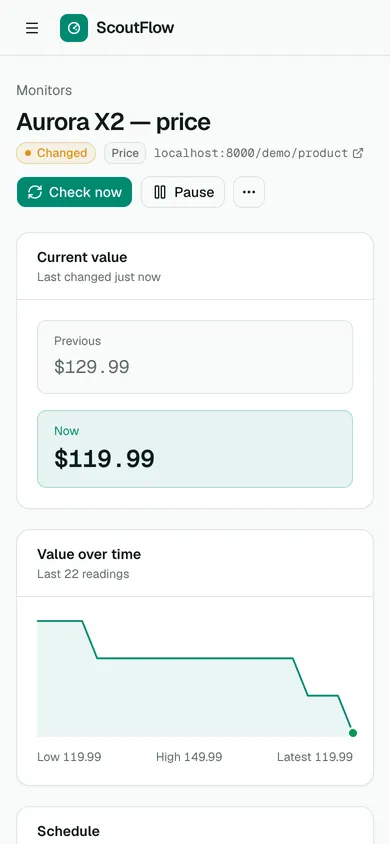
Monitor on a phone
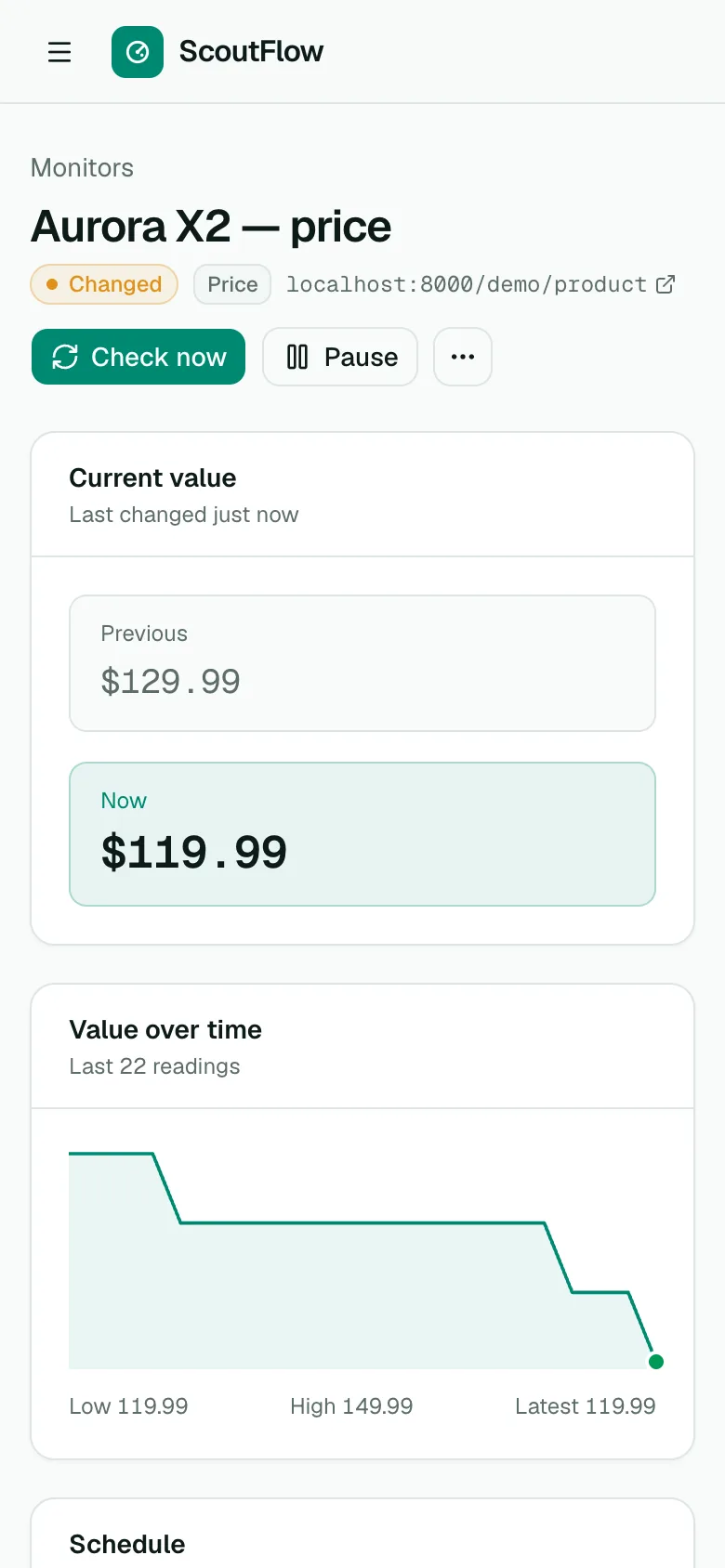
Captured from the app running locally with its seeded demo data. Select an image to open it full size.
Architecture
How the pieces fit
- Scheduler → Safe fetcher
- Check now → Safe fetcher
- Safe fetcher → Extractors
- Extractors → Comparison
- Comparison → Alerts
- Comparison → Database
- Core service
- External system
- Storage / entry point
Core features
What's in it
Five monitor types
Text, price (locale-aware parsing), availability, page content with ignorable selectors, and a JSON field by path.
Readable changes
Word diffs that collapse unchanged runs, price deltas with percentages, and in-stock/out-of-stock transitions.
Live “Check now”
The UI follows each stage of a manual check as it happens, with a cooldown and one check per monitor at a time.
Alerts
Discord (mentions disabled, markdown escaped), Telegram (HTML-escaped) and HMAC-signed webhooks; one alert at the failure threshold.
Selector tester
Try a selector against the live page before saving and see exactly what would be recorded.
Responsible by design
robots.txt respected, per-host request spacing, an honest user agent and a page-size cap. No CAPTCHA or anti-bot evasion.
Technical decisions
Interesting problems, and how they're solved
- 01
A failure is never a change
Failures are a separate outcome and never overwrite the stored value, so a timeout can't trigger a false “price changed”.
- 02
SSRF checks at every hop
URLs are validated when saved, before each request and at every redirect, against resolved addresses including IPv4-mapped IPv6.
- 03
Output escaping per channel
Page content goes into alerts, so Discord mentions are disabled and Telegram HTML is escaped — no @everyone from a scraped headline.
- 04
A seed that really runs
The demo week is produced by real checks against built-in demo pages, then back-dated — the history on screen is genuine output.
started = time.perf_counter()
redirects: list[str] = []
current = url
try:
    async with _client() as client:
        while True:
            await _space_requests(urlsplit(current).hostname or "")
            response, body = await _raw_get(client, current, accept)
            if response.is_redirect and "location" in response.headers:
                if len(redirects) >= settings.max_redirects:
                    raise CheckFailure("http_error", "Too many redirects.", response.status_code)
                nxt = urljoin(current, response.headers["location"])
                try:
                    await validate_url(nxt)
                except UnsafeURL as exc:
                    raise CheckFailure("invalid_config", f"The page redirected to a blocked address. {exc}") from exc
                redirects.append(nxt)
                current = nxt
                continue
            break
except httpx.TimeoutException as exc:
    raise CheckFailure("timeout", f"No response within {settings.http_timeout_seconds:g} s.") from exc
except httpx.TransportError as exc:
    raise CheckFailure("network", _network_message(exc)) from exc
Stack & skills
Built with
Technology
- Python
- FastAPI
- httpx
- asyncio
- BeautifulSoup
- SQLAlchemy
- Next.js
- TypeScript
- shadcn/ui
What this project demonstrates
- Scraping done responsibly
- Async scheduling
- Change detection & diffs
- SSRF protection
- Alert integrations
Repository & demo
Run it yourself
Seeded demo account: demo@scoutflow.dev / scoutflow-demo-1234. Monitors watch built-in demo pages you can change from the Demo lab.
No public live demo is hosted. Everything below runs locally with Python 3.12+ and Node 20+.
$ git clone https://github.com/Moeijiro/scoutflow.git
$ cd scoutflow
$ make install
$ make seed
$ make api
$ make web
Have a project in mind?
I build APIs, automation systems, Discord integrations and full-stack applications. Tell me what it should do and I'll tell you how I'd build it.